IRS Raises HSA and HDHP Dollar Limits for 2019

Close-up of a hand writing on paper with a pen.

The annual contribution limitations for health savings accounts (HSAs) and high-deductible health plans (HDHPs) are increasing for 2019 according to Revenue Procedure 2078-30. HSAs are subject to annual aggregate (employer + employer) contribution limits. In order for an employee to contribute to an HSA, he or she must be enrolled in an HDHP meeting minimum deductible and maximum out-of-pocket thresholds. HSA participants age 55 or older are allowed to contribute additional catch-up contributions.

The contribution, deductible and out-of-pocket limitations for 2019 are shown in the table below (2018 limits are included for reference).


Note that the Affordable Care Act (ACA) also applies an out-of-pocket maximum on expenditures for essential health benefits. However, employers should keep in mind that the HDHP and ACA out-of-pocket maximums differ in a couple of respects. First, ACA out-of-pocket maximums are higher than the maximums for HDHPs. The ACA’s out-of-pocket maximum was identical to the HDHP maximum initially, but the Department of Health and Human Services (which sets the ACA limits) is required to use a different methodology than the IRS (which sets the HSA/HDHP limits) to determine annual inflation increases. That methodology has resulted in a higher out-of-pocket maximum under the ACA. The ACA out-of-pocket limitations for 2019 were announced in the 2019 Notice of Benefit and Payment Parameters and are shown in the table below (2018 limits are included for reference).
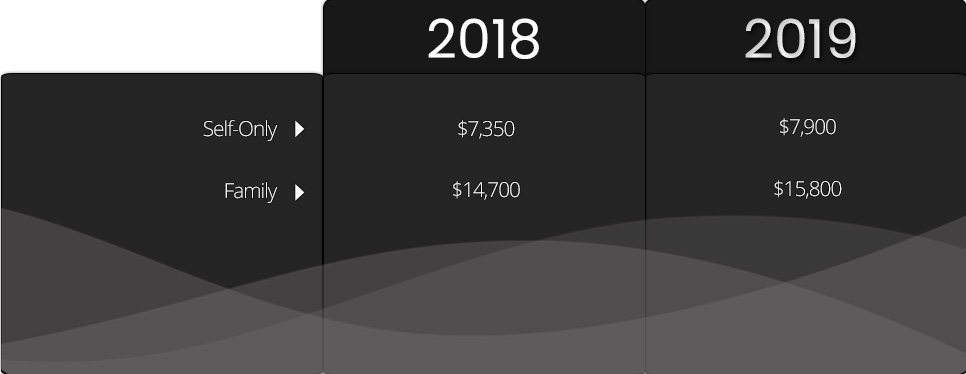


Second, the ACA requires that the family out-of-pocket maximum include “embedded” self-only maximums on essential health benefits. For example, if an employee is enrolled in family coverage and one member of the family reaches the self-only out-of-pocket maximum on essential health benefits ($7,900 in 2019), that family member cannot incur additional cost-sharing expenses on essential health benefits, even if the family has not collectively reached the family maximum ($15,800 in 2019).

The HDHP rules do not have a similar rule, and therefore, one family member could incur expenses above the HDHP self-only out-of-pocket maximum ($6,750 in 2019). As an example, suppose that one family member incurs expenses of $10,000, $7,900 of which relate to essential health benefits, and no other family member has incurred expenses. That family member has not reached the HDHP maximum ($15,800 in 2019), which applies to all benefits, but has met the self-only embedded ACA maximum ($7,900 in 2019), which applies only to essential health benefits. Therefore, the family member cannot incur additional out-of-pocket expenses related to essential health benefits, but can incur out-of-pocket expenses on non-essential health benefits up to the HDHP family maximum (factoring in expenses incurred by other family members).

Employers should consider these limitations when planning for the 2019 benefit plan year, however we understand that all of these acronyms (HDHP, HSA, ACA) and all of the rules and limitations attached to them can be mind boggling! We provide this information to keep you updated, but REST ASSURED! We are here to guide you and your employees through the maze! We are dedicated to help you provide the best group health benefits, meeting both the needs of your company and those of your employees.

Why can you trust us?

We have a qualified team of experts ready to take care of your health insurance needs. Our team thrives to offer the best guidance and customer service posssible.

CONTACT US TODAY
© 2025 Washington Health Insurance Agency | Privacy Policy

Small Business Health Insurance Plans in Washington

Finding the right health insurance for a small business in Washington State takes more than picking a plan off a rate sheet. With 10 to 50 employees, your company falls into the ACA small group market, which means every carrier must offer plans that cover Essential Health Benefits (EHBs) and follow community rating rules. Washington small group market is one of the most competitive in the country, with dozens of carriers fighting for your business.

At Washington Health Insurance Agency, we hold appointments with every health insurance carrier in the state. That means we compare every fully insured and level-funded option available to your company, then narrow the field to the top three most competitive plans. No call centers, no junior staff. Just direct access to senior-level brokers who know Washington insurance landscape inside and out.

Ready to compare your options? Get started with a free consultation or call us at 1-833-292-8844.

What Changed for Small Group Plans in 2026?

Washington State expanded its Essential Health Benefits benchmark plan effective January 1, 2026. If you purchase a small group insured health plan in Washington, these new benefits are automatically included in your coverage:

These expanded EHBs apply to all small group insured plans with plan years starting on or after January 1, 2026. If your current plan renewed before that date, you will see these benefits added at your next renewal.

How Does Small Group Health Insurance Work in Washington?

Under the Affordable Care Act, a small group is defined as a business with 1 to 50 full-time equivalent employees. Washington follows this federal definition. Here is how the small group market works in practice:

Comparing Small Business Health Insurance Options for Washington Employers

Feature Fully Insured Level-Funded Self-Funded
Premium predictability High — fixed monthly premium Moderate — capped monthly cost Variable — pay actual claims
Cost savings potential Lower 10–25% vs. fully insured 20–40% vs. fully insured
Claims risk Carrier assumes all risk Shared — stop-loss caps your exposure Employer assumes claims risk
Best for 10–25 employees, predictability-focused 20–50 employees, moderate risk tolerance 50+ employees or low-claims groups
WA carrier access (WHIA) All WA carriers All level-funded carriers TPA + stop-loss marketplace
Plan flexibility Standard ACA plans Customizable benefits Fully customizable

Fully Insured Plans

The most common option for small groups. The insurance carrier assumes all risk, and your company pays a fixed monthly premium. Washington carriers like Premera Blue Cross, Regence, Kaiser Permanente, and Aetna all compete in this market. We request quotes from every one of them so you see the full picture.

Level-Funded Plans

A growing option for small groups with 10 or more employees. WHIA helps small employers evaluate level-funded health insurance plans that cap your monthly exposure while sharing in any claims savings. These plans combine a fixed monthly payment with stop-loss protection, giving your company the potential for refunds if claims come in lower than expected. They offer more flexibility in plan design than traditional fully insured products, and they are becoming increasingly popular among Washington employers looking to control costs without taking on significant financial risk.

Self-Funded Plans

For groups with favorable claims histories, WHIA also evaluates self-funded health plans that can deliver 20–40% savings vs. fully insured premiums. Under a self-funded arrangement, your company pays actual claims costs rather than a fixed premium. Stop-loss insurance protects against catastrophic claims, and a third-party administrator (TPA) handles day-to-day plan management. Self-funded plans are fully customizable and exempt from many state insurance mandates.

Health Reimbursement Arrangements (HRAs)

Washington small businesses can pair group coverage with an HRA to help employees cover out-of-pocket costs. A first-dollar HRA with debit card access is one strategy WHIA implements to give employees immediate access to reimbursement funds without filing paperwork.

Not sure which plan type fits your business? Schedule a free phone consultation and we will walk you through the options.

Washington State Compliance Requirements for Small Group Employers

Running a small business in Washington comes with specific health insurance compliance obligations in 2026:

Why Washington Businesses Choose WHIA for Small Group Coverage

Most brokers work with a handful of carriers and push the plans that pay them the highest commissions. We do the opposite. WHIA is appointed with every health insurance carrier in Washington State, so we shop the entire market on your behalf. Our $2,500 advisory fee is fixed and transparent, backed by a guarantee: if we cannot demonstrate at least $5,000 in savings, we refund the fee in full.

Here is what that looks like in practice:

Frequently Asked Questions About Small Group Health Insurance in Washington

How many employees do I need to qualify for small group coverage?

In Washington State, any business with at least one W-2 employee (other than the owner) can purchase a small group plan. The small group market covers businesses with 1 to 50 full-time equivalent employees.

When is open enrollment for small group plans in Washington?

Unlike individual market plans, small group plans do not follow a fixed open enrollment window. Your company can start or renew coverage at any time of year. Most businesses align their plan year with their fiscal year or a January 1 start date.

Can I keep my current plan if I switch brokers?

Yes. Switching to WHIA does not change your plan, your benefits, your medical cards, or your premiums. A simple Broker of Record form transfers your account to us, and we handle everything from there. You can make the switch at any time, not just at renewal.

What are the new 2026 Essential Health Benefits in Washington?

Starting with plan years beginning January 1, 2026, Washington added hearing aid coverage (annual exam plus one hearing aid per ear) and expanded laboratory services (point-of-care genetic testing) to the state EHB benchmark plan. All small group insured plans must include these benefits.

Get a free benefits analysis for your small business. Start here or call 1-833-292-8844 to speak with an account manager today.